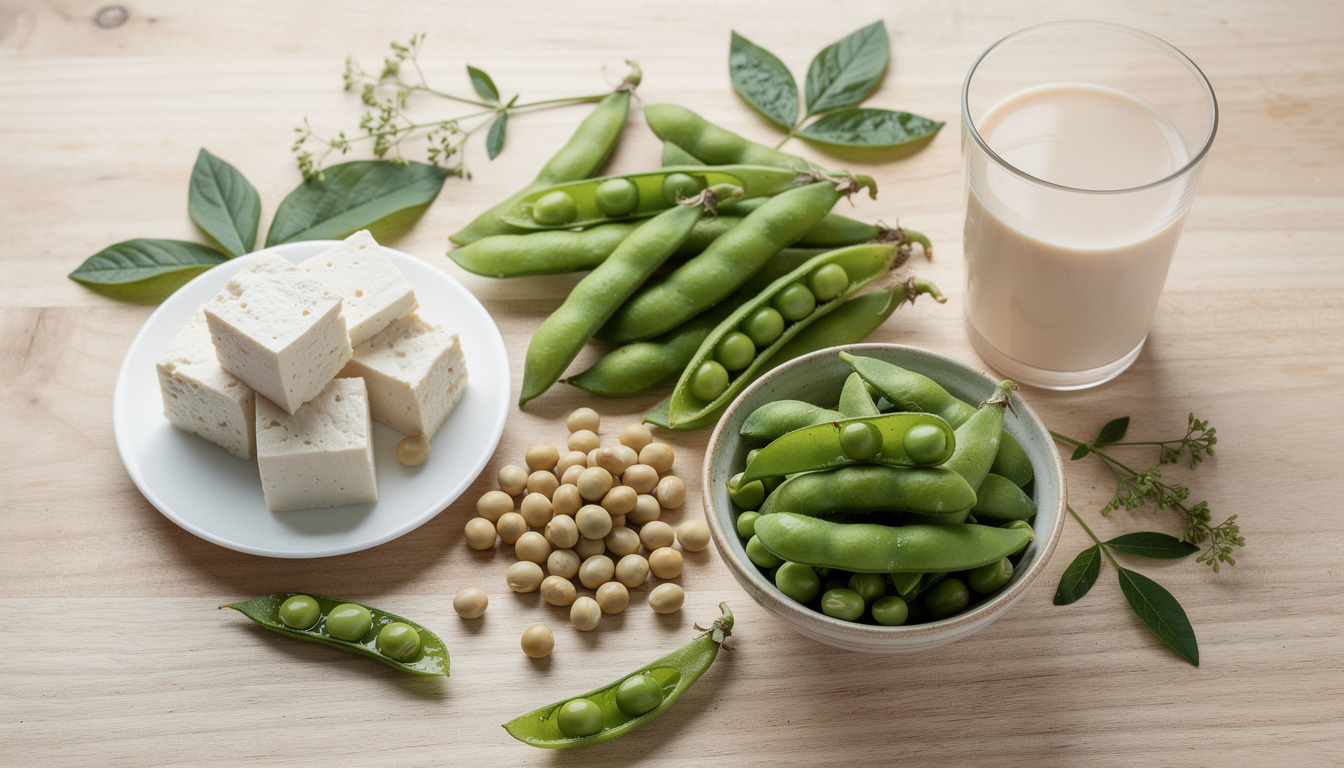
Soy has long been celebrated as a flagship food of the dietary transition, notably due to its richness in plant-based proteins. Yet, in 2026, this oilseed still sparks many debates, fueled by questions about its hormonal effects, environmental impact, and potentially undesirable effects. Let’s analyze together the benefits of soy, its risks, as well as the misconceptions surrounding it, to better understand how to incorporate this food into a healthy and balanced diet.
The benefits of soy: a quality source of plant-based proteins
Soy is an interesting source of complete proteins, meaning it provides all the essential amino acids for the body. Its composition, rich in fiber, vitamins, minerals, and unsaturated fatty acids, makes it a nutritious food appreciated in vegetarian and flexitarian diets. Among soy-based products, there are notably tofu, plant-based drinks, as well as soy-based steaks and desserts.
Consumed in moderation, soy can help diversify protein sources and reduce meat consumption, which is beneficial for cardiovascular health and the environment. Isoflavones, a type of phytoestrogens found in soy, have also been studied for their potential role in alleviating certain menopause symptoms and preventing bone loss.
Intakes to moderate due to phytoestrogens
Soy phytoestrogens are plant compounds that can partially mimic the action of estrogens in men and women. This particularity raises questions about their possible impact on the hormonal system, especially in certain sensitive groups such as children, pregnant women, or women of childbearing age.
The National Health Safety Agency thus formally recommended in 2025 to limit the consumption of soy-based foods in school cafeterias, nurseries, or nursing homes, to avoid excessive exposure to isoflavones. The risks mainly concern fertility and hormonal development, especially in cases of high and repeated consumption.
Risks linked to soy and recommended precautions
The main issue with soy therefore lies in its isoflavone content. Studies have shown that excessive consumption can disrupt fertility and cause toxic effects on the reproductive system. In France, it has been estimated that a significant portion of the population exceeds the recommended thresholds, particularly children aged 3 to 5 and adolescent girls.
Another important point: the nature of soy-based products plays a determining role. Fermented foods such as tempeh or miso generally contain fewer phytoestrogens than industrial ultra-processed products, like certain soy-based biscuits or desserts. The mode of production, soy variety, as well as manufacturing processes strongly influence the concentration of isoflavones.
Tips for consuming soy responsibly
- Limit ultra-processed soy-based products.
- Favor fermented foods and natural products (tofu, tempeh), from organic farming or locally grown soy without GMOs.
- Respect the thresholds recommended by ANSES: about 0.01 mg/kg/day of isoflavones for pregnant women and children, slightly more for the rest of the population.
- Avoid using soy-based infant formulas unless medically indicated, due to excessively high exposure to phytoestrogens.
- Encourage diversification of plant protein sources by including other legumes such as lentils, chickpeas, or red beans.
Soy and the environment: an impact with multiple facets
Contrary to some common beliefs, soy cultivated in France does not cause deforestation and is often GMO-free. Its ability to fix atmospheric nitrogen allows it to be part of virtuous agricultural practices, favoring crop rotation and limiting the use of chemical fertilizers. Local soy production therefore appears as a balanced alternative to meet current ecological challenges, provided that overconsumption and massive reliance on industrial products are avoided.
| Aspect | Description | Advice |
|---|---|---|
| Nutritional benefits | Rich in complete proteins, fiber, and unsaturated fatty acids | Moderate consumption, favor natural products |
| Health risks | Phytoestrogens potentially disrupting hormonal balance | Limit ultra-processed foods, avoid in young children and pregnant women |
| Environmental impact | French soy without GMOs, no deforestation, compatible with organic farming | Favor local and organic soy, limit excessive consumption |
Misconceptions about soy overcome by research
Far from being purely beneficial or harmful, soy is a perfect example of the complexity of a food whose effects vary depending on the quantity consumed, the form in which it is ingested, and the individual context. Far from the fears related to “endocrine disruptors,” it is now recommended to adopt a reasoned and diversified consumption.
To explore other topics related to healthy eating, you can consult this article on broccoli and its anticancer virtues or on the benefits of Skyr.
{“@context”:”https://schema.org”,”@type”:”FAQPage”,”mainEntity”:[{“@type”:”Question”,”name”:”Is soy dangerous for health?”,”acceptedAnswer”:{“@type”:”Answer”,”text”:”No, provided it is consumed in moderate quantities. The risks are mainly related to excessive exposure to phytoestrogens, especially in children and pregnant women.”}},{“@type”:”Question”,”name”:”Why does soy contain phytoestrogens?”,”acceptedAnswer”:{“@type”:”Answer”,”text”:”Phytoestrogens are plant compounds that resemble female hormones and can thus interact with the hormonal system, which may explain some effects of soy on health.”}},{“@type”:”Question”,”name”:”Which soy-based products should be favored?”,”acceptedAnswer”:{“@type”:”Answer”,”text”:”It is preferable to choose fermented products like tofu or tempeh, as well as those from organic farming and local non-GMO crops.”}},{“@type”:”Question”,”name”:”Does French soy contain genetically modified organisms (GMOs)?”,”acceptedAnswer”:{“@type”:”Answer”,”text”:”No, GMO soy cultivation is prohibited in France, and French soy is 100% GMO-free, environmentally friendly.”}},{“@type”:”Question”,”name”:”Can soy be consumed safely during pregnancy?”,”acceptedAnswer”:{“@type”:”Answer”,”text”:”As a precautionary measure, it is recommended to limit consumption of soy-based foods during pregnancy and breastfeeding to avoid excessive exposure to isoflavones.”}}]}Is soy dangerous for health?
No, provided it is consumed in moderate quantities. The risks are mainly related to excessive exposure to phytoestrogens, especially in children and pregnant women.
Why does soy contain phytoestrogens?
Phytoestrogens are plant compounds that resemble female hormones and can thus interact with the hormonal system, which may explain some effects of soy on health.
Which soy-based products should be favored?
It is preferable to choose fermented products like tofu or tempeh, as well as those from organic farming and local non-GMO crops.
Does French soy contain genetically modified organisms (GMOs)?
No, GMO soy cultivation is prohibited in France, and French soy is 100% GMO-free, environmentally friendly.
Can soy be consumed safely during pregnancy?
As a precautionary measure, it is recommended to limit consumption of soy-based foods during pregnancy and breastfeeding to avoid excessive exposure to isoflavones.