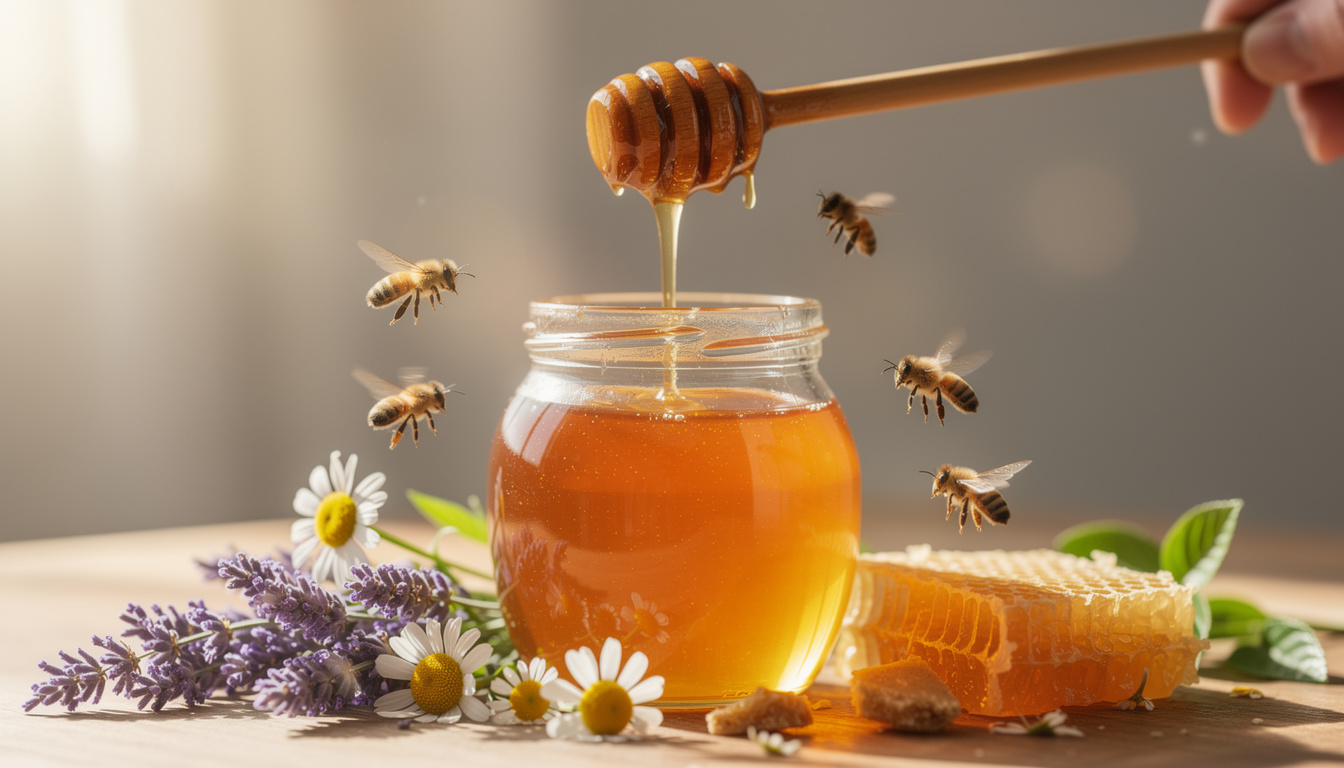
Honey, this sweet treasure we all know, is much more than just a simple natural sweetener. Rich in history and virtues, it captivates with its taste balanced between sweetness and slight acidity. Used for millennia, it sometimes accompanies our traditional remedies against everyday minor ailments, particularly throat irritations and sleep disorders. However, while it has many benefits, it also requires certain precautions, especially when it comes to regular consumption. In 2026, better understanding the medicinal properties of honey proves essential to incorporate it healthily into our diet.
The benefits of honey: at the heart of its composition and virtues
Honey is mainly composed of natural sugars, between 78% and 80%, with an average distribution around 38% fructose, 31% glucose, the rest being made up of maltose, sucrose, and various polysaccharides. This composition makes it a quick source of energy, much appreciated in case of low energy or before physical activity. Unlike refined sugars, it also provides minerals such as calcium, potassium, not to mention B vitamins, as well as essential trace elements like zinc and copper. These latter play a role in maintaining optimal cellular balance.
Another major asset lies in its natural antioxidants it abounds with: flavonoids and phenolic acids that help fight oxidative stress and inflammation. These bioactive compounds, particularly present in dark varieties of honey, support cardiovascular health and strengthen the body’s natural defenses. This richness in antioxidants makes honey an interesting complement to fruits and vegetables, sometimes overlooked in this category.
Honey: an energetic ally and metabolism protector
The combination of glucose and fructose facilitates rapid assimilation, propelling the body with an immediate dose of energy. Amanda Sauceda, dietitian, points out that it is precisely this property that makes honey particularly useful during times of fatigue or in preparation for physical effort. Thus, honey can act as an effective natural fuel, providing a boost without the harmful effect of industrial sugars.
Moreover, its mineral composition also contributes to overall vitality, helping the body function in a balanced way. Additionally, the antibacterial properties of honey also have a positive impact on the immune system, supporting natural defenses especially during seasonal changes.
Precautions for use: why moderate consumption?
Despite its strengths, excessive consumption of honey can cause blood sugar fluctuations. Indeed, even if its glycemic index is often lower than that of white sugar, too regular consumption may increase sugar peaks and drops in the blood, with possible consequences on diabetes risk and weight gain. A controlled experiment showed that daily ingestion of 50 grams of honey over several weeks could increase a key glycemic marker in diabetic patients. This highlights the importance of safe consumption to preserve good metabolic balance.
Another point to consider concerns raw honey, which may contain pollen particles or apicultural elements that can trigger allergies. People sensitive to pollen must remain particularly vigilant, as repeated exposure can cause skin or respiratory symptoms, and, in rare cases, severe reactions. These side effects urge caution, especially in case of allergic history.
Recommendations for balanced consumption
The World Health Organization classifies honey among “free sugars,” which means it is rapidly absorbed by the body, increasing the risk of excessive calorie intake and metabolism-related diseases. It recommends limiting these sugars to 10% of daily calorie intake, or even 5% for optimal health. Practically, this corresponds to about a tablespoon of honey, i.e., 20 to 30 grams per day for a healthy adult.
To fully enjoy the benefits while limiting glycemic impacts, it is advisable to integrate honey into recipes combining fibers or proteins, such as yogurt, oatmeal, or roasted vegetables. This combination slows sugar absorption and avoids sudden spikes. Moderate and well-thought consumption thus allows combining pleasure and reason.
From traditional uses to modern applications: diversity of honeys and their properties
Honey is not limited to a single profile: acacia, chestnut, thyme, lavender, manuka… Each offers a palette of specific tastes and benefits, ranging from digestive soothing to tonic or healing virtues. This diversity allows choosing the honey adapted to each need, health or gourmet.
| Honey variety | Taste and texture | Main benefits |
|---|---|---|
| Acacia | Sweet, delicate, remains liquid for a long time | Digestive, soothing |
| Chestnut | Strong, woody, crystallizes quickly | Rich in minerals |
| Thyme | Aromatic, intense, variable | Respiratory, tonic |
| Lavender | Floral, fragrant, fine crystallization | Relaxing, anti-stress |
| Manuka | Unique, slightly bitter, creamy | Antibacterial, healing |
Practical advice for choosing your organic honey
To ensure quality honey, favor certified organic products, from beekeepers respecting a strict specification and favoring a preserved environment. This guarantees the absence of pesticides and other contaminants, which is important to best benefit from the medicinal properties of honey. Avoid honeys sold at low prices which may be cut with industrial syrups, compromising their authenticity and health benefits.
FAQ about honey: common questions and clear answers
{“@context”:”https://schema.org”,”@type”:”FAQPage”,”mainEntity”:[{“@type”:”Question”,”name”:”Can honey be stored indefinitely?”,”acceptedAnswer”:{“@type”:”Answer”,”text”:”Yes, honey is one of the few foods that can be stored for a very long time when kept in good conditions: dry place and at room temperature. Its natural crystallization does not mean it is spoiled.”}},{“@type”:”Question”,”name”:”Is it advisable to heat honey?”,”acceptedAnswer”:{“@type”:”Answer”,”text”:”It is preferable not to heat honey above 40°C in order to preserve its antioxidant and antibacterial properties. To incorporate it into a hot drink, wait for it to cool down.”}},{“@type”:”Question”,”name”:”Can honey be given to children?”,”acceptedAnswer”:{“@type”:”Answer”,”text”:”Honey is not recommended for infants under one year old because their digestive system is not yet mature enough to neutralize certain spores that may be present in honey.”}},{“@type”:”Question”,”name”:”Do all honeys have the same effects on health?”,”acceptedAnswer”:{“@type”:”Answer”,”text”:”Each variety of honey has a slightly different profile in terms of taste, texture, and benefits. Some, like manuka honey, have stronger antibacterial properties, while others are better for the digestive system or relaxation.”}},{“@type”:”Question”,”name”:”Why prefer organic honey?”,”acceptedAnswer”:{“@type”:”Answer”,”text”:”Organic honey comes from environmentally friendly production and ensures better sanitary quality. This guarantee reassures about the absence of pesticides or additives and enhances the natural properties of honey.”}}]}Can honey be stored indefinitely?
Yes, honey is one of the few foods that can be stored for a very long time when kept in good conditions: dry place and at room temperature. Its natural crystallization does not mean it is spoiled.
Is it advisable to heat honey?
It is preferable not to heat honey above 40°C in order to preserve its antioxidant and antibacterial properties. To incorporate it into a hot drink, wait for it to cool down.
Can honey be given to children?
Honey is not recommended for infants under one year old because their digestive system is not yet mature enough to neutralize certain spores that may be present in honey.
Do all honeys have the same effects on health?
Each variety of honey has a slightly different profile in terms of taste, texture, and benefits. Some, like manuka honey, have stronger antibacterial properties, while others are better for the digestive system or relaxation.
Why prefer organic honey?
Organic honey comes from environmentally friendly production and ensures better sanitary quality. This guarantee reassures about the absence of pesticides or additives and enhances the natural properties of honey.