Yes, a tablet designed for seniors can help an elderly parent in daily life, provided it is chosen for what it actually does (maintaining visual contact, reminding treatments, sharing blood pressure measurements with the family) and not for its technical sheet. It does not replace a visit or a doctor, and it is not suitable for all situations, especially in cases of established cognitive disorders. Here is how to decide, at a time of year when monitoring around elderly people abruptly decreases.
What summer 2026 reinforced, and what stops in mid-September
This summer marked a quiet turning point for caregiver families. A decree of July 3, 2026, relayed by the specialized press on senior housing, expanded the automatic registration in the municipal register of vulnerable persons: beneficiaries of the personalized autonomy allowance (APA) and the disability compensation benefit (PCH) are automatically entered, representing nearly two million people concerned. Practically, this means calls and visits from the municipal social action center during heat episodes.
However, this system is seasonal. The seasonal heatwave watch managed by Public Health France and the Ministry of Health runs until September 15. After that, CCAS calls become less frequent, children return to work, grandchildren to school, and the phone rings less. The organized monitoring stops in mid-September, not the vulnerability, and it is precisely this gap that worries families at the start of the school year.
A useful clarification if your parent is reluctant to be registered somewhere: the register is optional, one can request to be removed, and refusing registration does not remove any rights or assistance at all. Registration itself remains possible all year round at the town hall or the CCAS, not just in June.
September isolation is not just an impression
The Petits Frères des Pauvres network has been documenting the relational isolation of the elderly for several years: about two million people aged 60 and over live isolated from their family and friendly circles, and nearly 530,000 are in a so-called social death situation, that is to say almost no interaction. The DREES studies on living conditions of elderly people point in the same direction.
Why talk about it in a prevention section? Because isolation is not just a heartbreak. When no one visits, loss of appetite develops without witnesses, a fall without apparent severity is not reported, a medical appointment is postponed, a treatment is forgotten for several days in a row. These are not spectacular dramas, they are slow drifts that someone would have noticed. A tablet is primarily used so that someone quickly notices that something is wrong.
Three functions that really make a difference in health
The senior tablet market (Facilotab, Ardoiz, LiNote, among others) is often presented from the angle of technical comparisons. Sorting is simpler if you start from prevention uses.
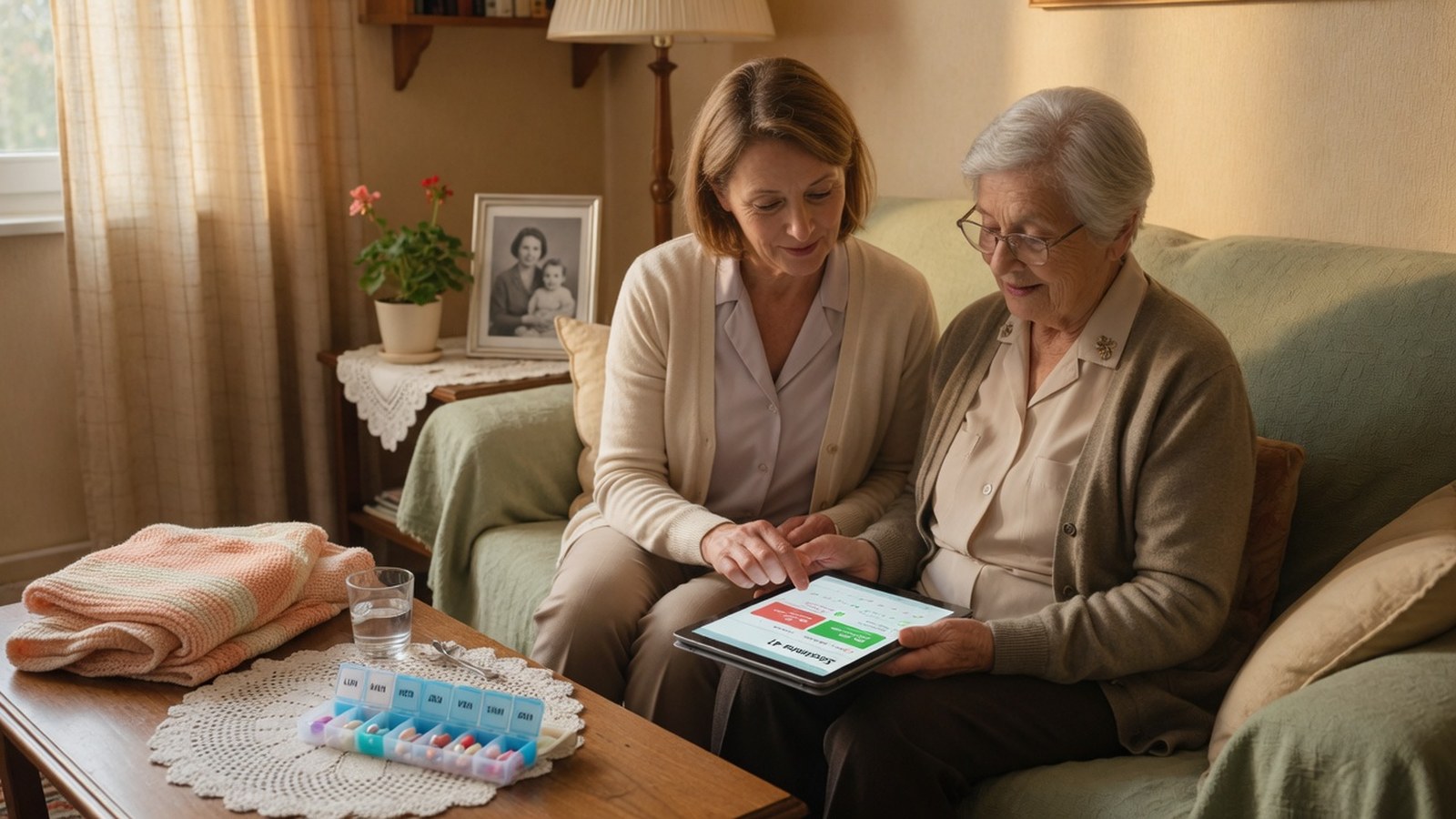
- Remotely programmable treatment reminders. On widely distributed medication adherence apps (Medisafe is the best known), the caregiver sets the times from their own phone. The person confirms intake with a gesture, and failure to confirm triggers a notification on the family side. This is the key mechanism: you are alerted of the forgetfulness without having to call to check, which avoids the controlling relationship that weighs on everyone. We go deeper into this setting in our article on optimizing medication reminders on a senior tablet.
- Recording and sharing blood pressure monitoring. Home self-measurement has precise rules. The Health Insurance recalls the principle of three measurements in the morning and three in the evening, several days in a row before the consultation. A tablet that allows entering or receiving these values, then sending them to the doctor or showing them at the appointment, transforms a notebook lost in a drawer into usable information.
- Video calls, not just for chatting. Seeing a face, a kitchen, an outfit, means perceiving what a voice call masks: fatigue, confusion, empty fridge, shutters closed in broad daylight. Many models designed for seniors automatically answer calls from authorized contacts, which solves the issue of a parent who does not know how or dare not answer.
France 3 Grand Est presents in video a touchscreen tablet specially designed for seniors, simple to use, concretely illustrating how this tool promotes digital autonomy for elderly people.
@france3grandest Une tablette tactile, facile d’utilisation, speciale senior🧑🏻🦳👨🏻🦳#senior #personneagee #tablette #linote
♬ Acoustic guitar live performance Gentle and nimble in nature(1007339) – Melonest
If these topics resonate with you, I suggest joining the Medicial newsletter. Every week, I send you a clear and sourced health decryption, concrete landmarks to support an elderly relative without exhausting yourself, and prevention reminders that really matter. No miracle promises, just verified information and simple words, to be read quietly in the evening.
What the tablet will not do, and what is rarely told to you
This is the blind spot of most articles on the subject. Stéphanie Petit, neuropsychologist specialized in geriatrics interviewed by La Libre, warns about a field reality: a digital tool is very difficult to learn when cognitive disorders are already established. For a disoriented or confused person, late learning of an interface, even simplified, can generate anxiety and failure rather than autonomy. If your parent loses track of a conversation or no longer finds their bearings in their own home, the tablet is not the right first step: the issue to raise with the attending physician is the geriatric assessment.
Another nuance, on a widely circulated figure: a meta-analysis published in 2025 and widely relayed associates regular Internet use among elderly people with about 58% lower risk of cognitive disorder. This is a third-party study result, and it deserves to be read for what it is: a statistical association, not proof that a tablet protects the brain. People who are already better off cognitively, socially, and sensorily are also those who connect the most. No screen prevents a neurodegenerative disease.
Finally, a tablet is neither a fall detector nor telecare. If fall risk is the main issue, other devices need to be considered, and the opinion of a professional (attending physician, occupational therapist, department autonomy service) is the right starting point. This article does not replace a consultation: if in doubt about your parent’s health, talk about it to their doctor.
Choosing and funding without drowning in technical sheets
Two families coexist: tablets initially designed for seniors, with a streamlined interface and telephone customer service, and general-market tablets equipped with a simplified launcher, often cheaper but requiring someone comfortable to set them up. Count generally between 250 and 500 € for a dedicated model, sometimes with a monthly subscription for support and assistance services.
Three questions are better than a comparison table. To compare models in detail, this guide to choosing a senior tablet reviews technical criteria; just keep in mind that the first criterion remains remote support. Who will be able to administer it remotely, without traveling? Does customer service respond by phone, in French, patiently? Are the weight and screen size compatible with arthritic hands and declining vision? The real choice criterion is who will be able to administer the tool remotely, because a tablet that no one updates ends up in a drawer in three months.
On the budget side, aid exists, but it is very uneven depending on the territories. Some municipalities and CCAS offer checks or digital vouchers ranging from 50 to 150 €. Retirement funds, Carsat and MSA, can contribute under the home help aid, often in a range of 100 to 300 €, subject to income conditions and according to local applicable schemes. These amounts depend on local authorities and funds: the only reliable way to know is to call the CCAS of the municipality and the retirement fund of the concerned parent.
What I suggest to you this week, before the seasonal watch ends on September 15: a single call to the CCAS of your parent’s municipality to verify their registration in the vulnerable persons register and ask what the town hall offers in terms of digital equipment. Then a ten-minute video call test, with the tool he or she already has, at a fixed time, twice a week. If this appointment holds for three weeks, the dedicated tablet makes sense. If it does not hold, another form of presence must be built, and this can also be discussed with the attending physician.